Building skills where everyday life happens.
BLUINKWL provides individualized 1:1 ABA educational support in the home and community, with programming designed around each client’s communication, learning, behaviour, independence, daily living and functional life goals.
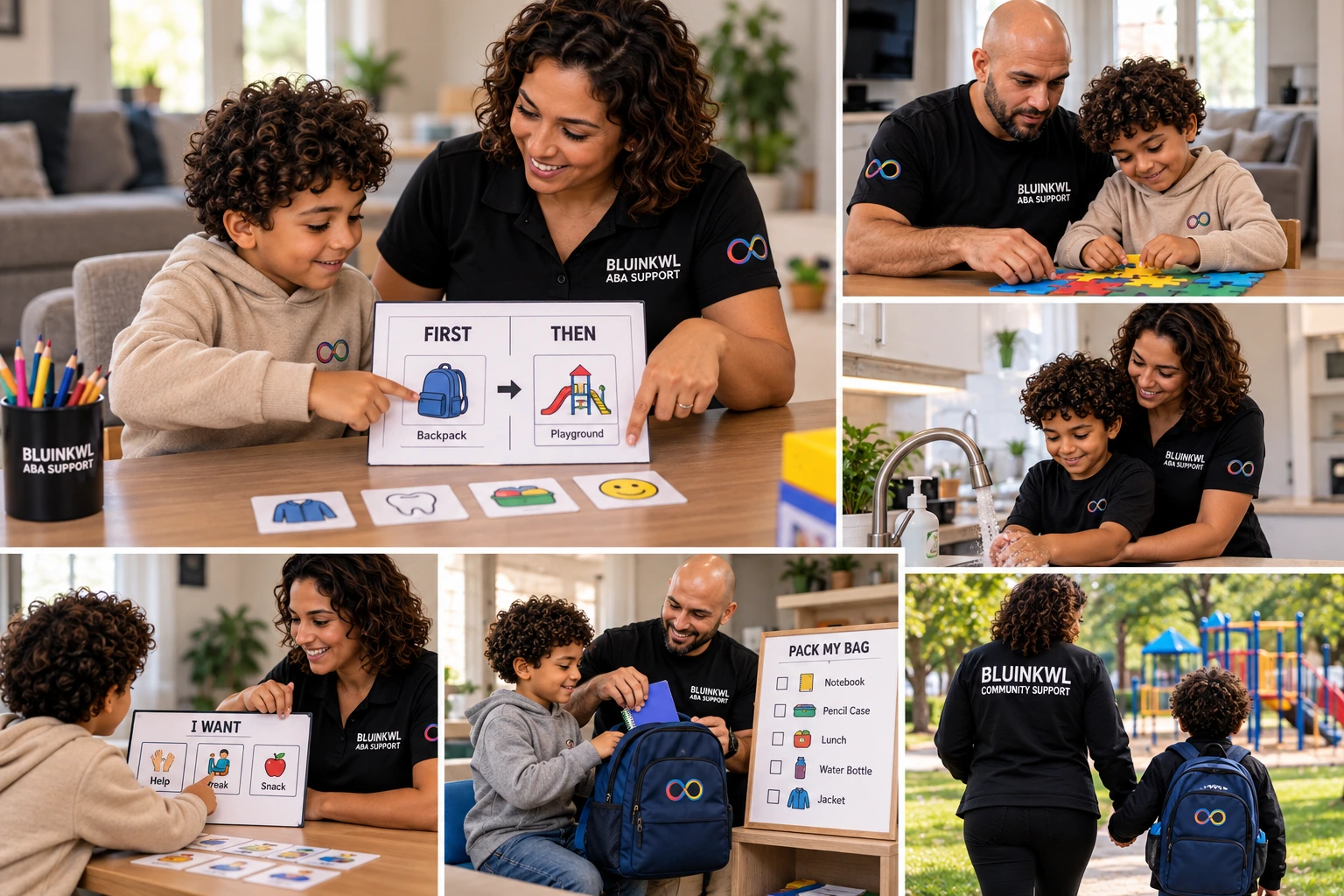 In-home & community ABA support • Individualized 1:1
Practical skills for home, routines and the community.
Learning does not happen in only one room. Depending on the individualized program and goals, ABA strategies can be used during everyday routines and appropriate community activities so the learner can practice meaningful skills in the environments where those skills are actually needed.
Programs are individualized according to the client’s strengths, needs, communication profile, developmental level, family priorities and clinical recommendations.
Individualized ABA support can target areas such as:
1:1 ABA Educational Support
Individualized teaching based on the learner’s goals, abilities and support needs. Sessions may use structured teaching, natural-environment learning, visual supports, reinforcement, prompting and other ABA-based strategies.
Communication & Language
Support functional communication, expressive and receptive language goals, making choices, requesting help or breaks, following directions and communicating needs appropriately.
Behaviour & Self-Regulation Support
Work on individualized behaviour goals, coping strategies, flexibility, transitions, emotional regulation, waiting, tolerance and replacement skills that support safer and more independent participation.
Social Skills Development
Practice interaction, turn-taking, personal space, play skills, appropriate social responses, peer interaction and other individualized social goals.
Daily Living & Independence
ABA support can be incorporated into practical routines such as dressing, hygiene, handwashing, organizing belongings, preparing for school or activities, completing household routines and increasing independence step by step.
School Readiness & Learning Skills
Practice attending, following instructions, sitting for appropriate periods, completing activities, transitions, visual schedules, task completion and other learning-to-learn skills that may support classroom participation.
Community-Based ABA Support
When appropriate to the individualized plan, skills can be practiced in community settings to support safety, transitions, waiting, following directions, communication, tolerating new environments and participating more independently outside the home.
Functional Life Skills
Programs may work on practical skills such as packing personal items, following a checklist, making simple choices, completing routines, understanding boundaries, community safety and other functional goals relevant to everyday life.
Helping skills transfer into real life.
A skill learned during a structured session may also need practice in other environments. When clinically appropriate and included in the client’s program, community-based ABA support can create opportunities to practice skills in natural settings.
Examples may include navigating transitions, staying with a caregiver or therapist, following safety directions, waiting appropriately, communicating needs, participating in a community activity, tolerating changes and using learned skills outside the home.
Community activities are selected according to the individual client’s goals, safety needs and program plan.
Examples of areas we may support
- Community safety and awareness
- Transitions between environments
- Waiting and following instructions
- Functional communication in natural settings
- Appropriate social interaction
- Flexibility and tolerance of changes
- Independence during everyday activities
- Generalizing skills across people and places
Small routines can build meaningful independence.
Daily living skills are an important part of functional development. Rather than teaching every learner the same routine, goals are selected according to what is meaningful and appropriate for that individual and family.
A complex routine can be broken into smaller achievable steps. The therapist can model the skill, provide the appropriate prompt, reinforce progress, collect data and gradually reduce assistance as the learner becomes more independent.
Daily-life goals may include
- Personal hygiene and handwashing
- Dressing and organizing clothing
- Packing a backpack or personal belongings
- Following morning or evening routines
- Cleaning up and completing simple household routines
- Using visual schedules and checklists
- Preparing for school or community activities
- Building greater independence with age-appropriate tasks
Goals should make sense for the child and family.
Families know their child’s everyday routines, challenges and priorities. Parent and caregiver input helps identify meaningful goals and areas where additional support may be useful.
When appropriate to the program, caregivers can receive guidance on strategies being used so skills can be supported consistently across daily routines and environments.
Individualized programming
There is no one-size-fits-all program. Goals, teaching strategies, prompting levels, reinforcement, data collection and progression are individualized and adjusted according to the learner’s program and clinical supervision.
In-home ABA and BJJ Movement-Based Therapy are separate services.
In-home and community ABA support focuses on individualized educational, behavioural, communication, independence and functional life goals in natural environments.
BJJ Movement-Based Therapy is centre-based only in Oshawa and is never provided in the client’s home. The BJJ program requires the appropriate martial-arts environment, matting, equipment, space, safety procedures and controlled session conditions.