A different way to learn, move and grow.
An individualized 1:1 program using real Brazilian Jiu-Jitsu and structured movement as the environment for developing meaningful skills, while incorporating principles and teaching strategies from Applied Behaviour Analysis (ABA).
We are an ABA agency — not a gym or martial arts academy.
BLUINKWL’s BJJ Movement-Based Therapy is an individualized 1:1 program delivered within an ABA service model with clinical supervision. Brazilian Jiu-Jitsu provides the movement environment while individualized goals, ABA-based teaching strategies, data collection and clinical oversight guide the program.
OAP funding is accepted for eligible services. We do not offer free trials because each program is designed individually around the client’s needs, goals, safety requirements and intake/assessment process.
Real Brazilian Jiu-Jitsu. Individualized teaching.
BLUINKWL BJJ Movement-Based Therapy is an individualized 1:1 program that uses Brazilian Jiu-Jitsu (BJJ) and structured movement as the environment for teaching and developing meaningful skills, while incorporating principles and strategies from Applied Behaviour Analysis (ABA).
It is not simply a traditional Brazilian Jiu-Jitsu class, and it is not traditional table-based therapy with martial arts added on.
It is a different approach developed specifically to bring movement, martial arts instruction, individualized goals and ABA-based teaching strategies together.
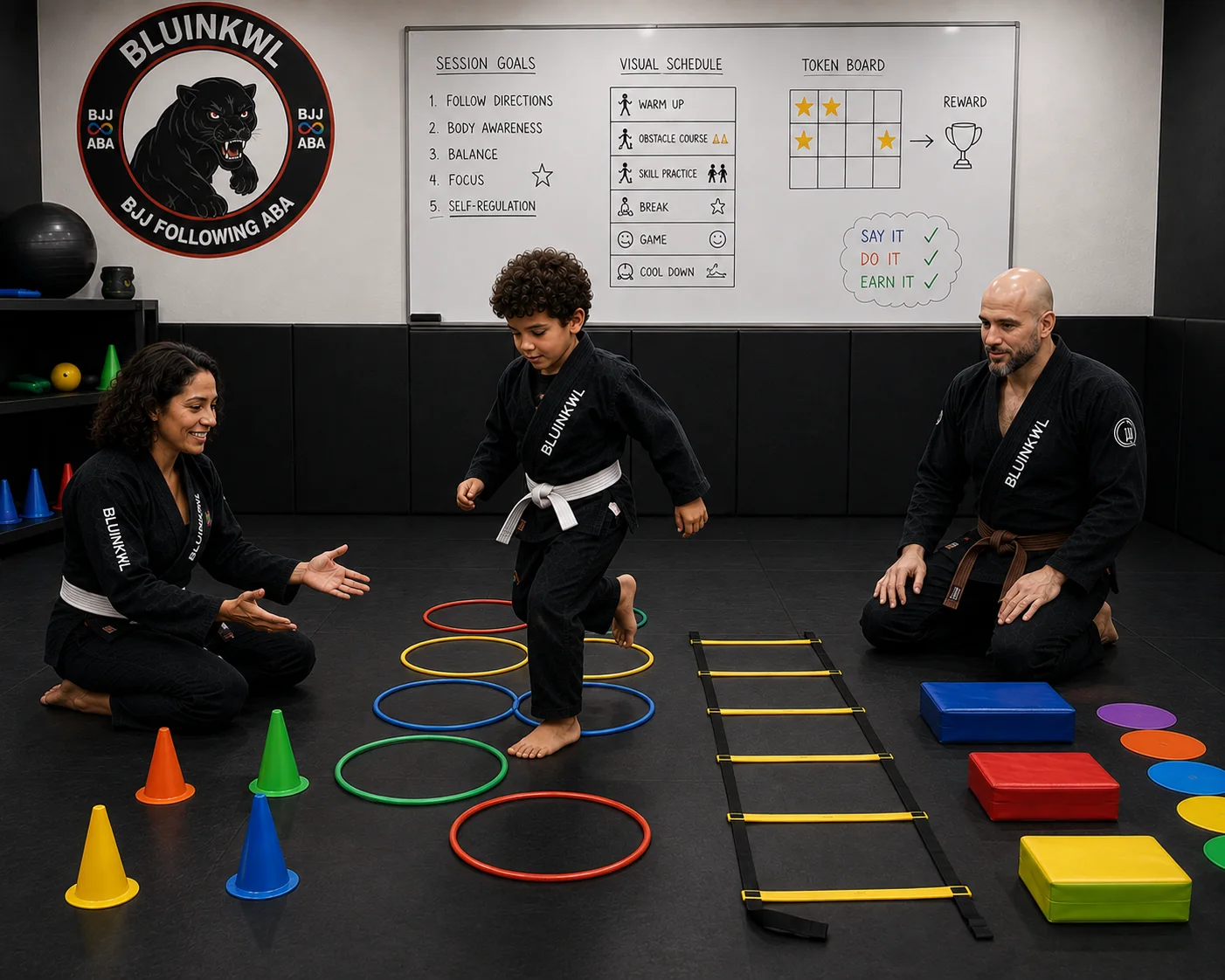 Structured movement • Individualized teaching
Your child is learning real Brazilian Jiu-Jitsu.
During sessions, your child is introduced to real, age- and ability-appropriate Brazilian Jiu-Jitsu fundamentals and movements.
Everything is adapted to the child’s developmental level, physical abilities, communication needs and learning style.
Individualized from the beginning
The goal is not to force a child into a standard lesson format. We adapt the pace, instruction, supports and expectations while still teaching authentic BJJ movement and fundamentals.
The difference is how we teach.
A traditional martial arts instructor generally teaches a class and expects students to follow the lesson within the structure of that group. Some children need a different starting point.
A child may have difficulty waiting, transitioning, following multi-step directions, maintaining attention, tolerating correction, communicating that they need a break, imitating movements, staying with an activity or regulating their body in a busy environment.
Instead of viewing those challenges simply as a reason the child cannot participate, we look at what skills and supports may help the child participate successfully.
ABA-based strategies may include
- Positive reinforcement
- Prompting and fading
- Shaping
- Task analysis
- Modeling and imitation
- Visual supports
- Breaking complex skills into smaller achievable steps
- Repetition and structured practice
- Teaching functional communication
- Gradually increasing expectations
- Individualized reinforcement and motivation
- Data collection and progress monitoring
Break the skill down. Build independence up.
If a BJJ technique contains five steps and your child cannot yet follow all five, we do not simply repeat the same instruction and expect the child to eventually understand.
We may break the movement into smaller components, teach one step at a time, provide the appropriate level of prompting, reinforce successful attempts, practice the skill and gradually reduce assistance as independence develops.
The martial art provides the movement. ABA helps guide how we teach the individual learner.
BJJ creates natural opportunities for development.
Focus & Attention
Practice looking, listening, attending to instructions, completing activities and returning attention to a task.
Discipline & Following Directions
Practice routines, responding to commands, waiting, completing tasks and understanding when an activity begins and ends.
Emotional & Self-Regulation
Practice tolerating challenges, waiting, managing frustration, requesting breaks appropriately, transitioning and returning to a task.
Motor Planning & Coordination
Activities can involve balance, posture, bilateral coordination, crossing the midline, spatial awareness, strength, mobility and sequencing movements.
Communication
Create natural opportunities to request help or a break, communicate discomfort, respond to instructions, make choices and interact appropriately.
Confidence
Skills are introduced progressively. Accomplishing something that was previously difficult can support a sense of competence and confidence.
Social Readiness
Practice waiting, taking turns, respecting space, listening to an instructor, changing activities, working with a partner and following group-style routines.
Safety & Self-Defense
Learn age- and ability-appropriate BJJ and self-defense concepts in a controlled environment. The purpose is confidence, body awareness, boundaries and safety—not aggression.
Your child does not have to be ready for a group class before coming to us.
For some children, the group environment itself is the barrier. A busy martial arts class can involve noise, multiple children, physical proximity, rapid instructions, waiting, transitions, partner changes and many things happening simultaneously.
A child may be interested in martial arts but not yet have all the skills necessary to participate comfortably and safely in that environment. That is why we begin individually.
One child. One instructor/therapist. Individualized goals.
We can slow the lesson down, repeat an instruction, use visuals, modify an activity, provide additional practice, incorporate breaks, change the level of prompting and progress according to the individual child. There is no expectation that every child must progress at the same speed.
The goal is not to keep your child 1:1 forever.
When appropriate, we want skills developed individually to support greater independence and inclusion.
1:1 Support → Skill Development → Increased Independence → Social Readiness → Greater Inclusion
For a child whose goal is eventually participating in a traditional BJJ class, we can work on foundational skills that may help make that transition more successful.
Not every child’s goals will be identical, and progression into a group environment is never guaranteed or rushed. Decisions are based on individual needs, safety, progress and readiness.
No previous BJJ experience is required.
Your child does not need any previous martial arts experience.
The program can begin with very basic skills such as entering the training area, following a simple direction, imitating one movement, learning basic body positions, requesting a break and becoming comfortable with the environment.
We build from the child’s starting point.
A different starting point for children who need one
We created this program because sometimes a child does not need to be told:
“They aren’t ready for martial arts.”
Sometimes they need a martial arts environment that is ready for them.
Every child starts from a different place. We start from theirs.
BJJ Movement-Based Therapy is gym-based only.
BLUINKWL’s BJJ Movement-Based Therapy is delivered in our designated martial-arts environment in South Oshawa. It is not provided as an in-home service.
Brazilian Jiu-Jitsu involves physical movement, partner work, controlled grappling positions, transitions and specialized instruction. The program therefore requires proper matting, sufficient training space, appropriate equipment, safety procedures and an environment that meets our operational and liability requirements.
Why the gym environment matters
- Purpose-built martial-arts matting
- Controlled and appropriate training space
- Safety procedures for BJJ movement and drills
- Access to program equipment and visual supports
- Appropriate supervision and session setup
- Program safety and liability requirements
For these reasons, BJJ-based therapeutic sessions cannot be conducted in the client’s home.
Families seeking home-based support can explore our Educational In-Home Services and ABA/IBI Services.
Sometimes they need a martial arts environment that is ready for them.
Individualized BJJ, structured movement and ABA-based teaching strategies—starting from the individual learner.